
The fastest way to nail your hoodie size: measure your chest circumference, or lay a favorite hoodie flat and measure pit-to-pit, then match that number to the brand’s size chart. For a standard fit, look for roughly 1 to 2 inches of pinch room at the chest. For an oversized fit, aim for 2.5 inches or more, or just follow the brand’s dedicated oversized chart if it has one.
A few things to check before you buy:
- Measure chest circumference or pit-to-pit on a hoodie you already own and love.
- Standard fit: 1 to 2 inches of pinch at the chest.
- Oversized fit: noticeably more than two inches of pinch, or follow the brand’s oversized size chart if available.
- Heavy, non-stretch fabric can shrink or sit stiffer, so check the material before finalizing your size.
Key Takeaways
Matching a hoodie size to your body or a favorite garment’s pit-to-pit measurement, rather than trusting the size label alone, is the most reliable way to avoid a return.
| Point | Details |
|---|---|
| Measure before you shop | Get your chest circumference or a favorite hoodie’s pit-to-pit before comparing charts. |
| Use the pinch test | Aim for 1 to 2 inches of pinch for regular fit, 2.5+ inches for oversized. |
| Check fabric weight | Heavyweight fabric (400+ GSM) can fit tighter than the number suggests, so consider sizing up. |
| Know your layering plan | Size down for under-jacket wear, size up for a boxy layered look over a t-shirt. |
| Compare garment measurements | ThePreciousLamb lists pit-to-pit and HPS on product pages so you can check numbers before checkout. |
Where Can You Verify Your Hoodie Measurements?
- Hoodie size chart generator for inch-to-centimeter conversions.
- Complete hoodie fit guide for pinch-test benchmarks.
- How to measure your chest for a step-by-step body measurement walkthrough.
Table of Contents
- How Do You Measure Your Body for a Hoodie?
- How Do You Measure an Existing Hoodie to Compare It to a Chart?
- What Fit Type Should You Choose: Slim, Regular, or Oversized?
- Does Fabric Weight Change What Size You Should Buy?
- How Do You Convert Between Inches, Centimeters, and Chest Charts?
- How Do You Decide Between Sizes While Shopping?
- How Should Layering Change the Hoodie Size You Pick?
- Do Men’s, Women’s, and Unisex Hoodies Use the Same Size Charts?
- How Does Pullover vs. Zip-Up Style Affect Sizing?
- What People Get Wrong About Hoodie Sizing
- Sources
How Do You Measure Your Body for a Hoodie?
Grab a soft tape measure and measure over a light shirt, not bare skin, since a hoodie sits on top of layers anyway.
- Chest: Wrap the tape around the fullest part of your chest, usually right at nipple level, keeping it level front to back. Write down the full circumference, then note that most garment charts also list a “pit-to-pit” figure, which is roughly half that number.
- Sleeve length: Brands measure this two different ways, so check which one applies. Some measure from the center-back neck, across the shoulder, and down to the wrist. Others measure only from the shoulder point (where the sleeve seam sits) to the wrist. The center-back method always produces a longer number for the exact same sleeve, so never compare a center-back figure to a shoulder-point figure without adjusting.
- Body length (HPS to hem): HPS stands for high point shoulder, the small bump where your neck meets your shoulder. Measure straight down from there to wherever you want the hem to land.
Stand naturally with arms relaxed at your sides. Don’t suck in your chest or measure over a puffy jacket. A tape that’s pulled too tight will shave off half an inch and send you into a size that’s too small.
Pro Tip: Measure twice and write both numbers down. Chest measurements can shift by half an inch depending on whether you’re standing relaxed or holding your breath.
How Do You Measure an Existing Hoodie to Compare It to a Chart?
Laying a hoodie flat and measuring it directly is often more reliable than measuring your body, because it removes guesswork about posture or breathing. It also tells you exactly how a specific model runs, rather than how you’d theoretically fit a “medium” in the abstract.
Here’s how to do it:
- Lay the hoodie flat on a bed or table, front side up, with sleeves smoothed out (not stretched).
- Measure straight across from one armpit seam to the other. This is your pit-to-pit number.
- Double the pit-to-pit figure to get the full chest circumference, since most size charts list pit-to-pit and double it for the full chest measurement.
- Measure HPS to hem for body length, and sleeve length from the shoulder seam to the cuff.
- Log all four numbers in your phone’s notes app under the brand name, so you can pull them up while shopping later.
Some brands list “1/2 chest” (the pit-to-pit number) on their charts, while others list “full chest” (the doubled number). Confusing the two is the single most common reason people order the wrong size online, so always check which one a chart is showing before you compare.
What Fit Type Should You Choose: Slim, Regular, or Oversized?
Fit language on a product page (“slim,” “regular,” “oversized”) is vague on its own, but it maps to concrete numbers once you know what to check. Five zones tell you whether a hoodie actually fits the way its label claims: shoulder seam placement, chest pinch, sleeve cuff placement, hem length, and hood drape.
The chest pinch test is the quickest gut check. Pinch the fabric at your chest while wearing the hoodie:
- Athletic/slim: 0.5 to 1 inch of pinch. The fabric sits close, shoulder seams land right at your natural shoulder bone.
- Regular: 1 to 2 inches of pinch, which is the standard benchmark for a comfortable everyday fit.
- Relaxed/oversized: 2.5 to 3.5 inches of pinch. Shoulder seams drop past your shoulder bone, sleeves run longer, and the hem sits lower on the hip or thigh.
Drop-shoulder construction, common in oversized and streetwear-style hoodies, moves the whole judgment call. On a drop-shoulder pattern, the seam is supposed to sit an inch or two down your arm, not on your shoulder bone, so applying a slim-fit checklist to an oversized cut will make you think something’s wrong when it’s actually built correctly. Shoulder seam placement alone catches fit problems that a chest measurement misses entirely, which is why it belongs in every fitting check regardless of which silhouette you’re going for.
Does Fabric Weight Change What Size You Should Buy?
Yes, and this is the detail most sizing charts skip entirely. Fabric weight, measured in grams per square meter (GSM), changes how a hoodie drapes and how much room it actually feels like it’s giving you, independent of the size label.
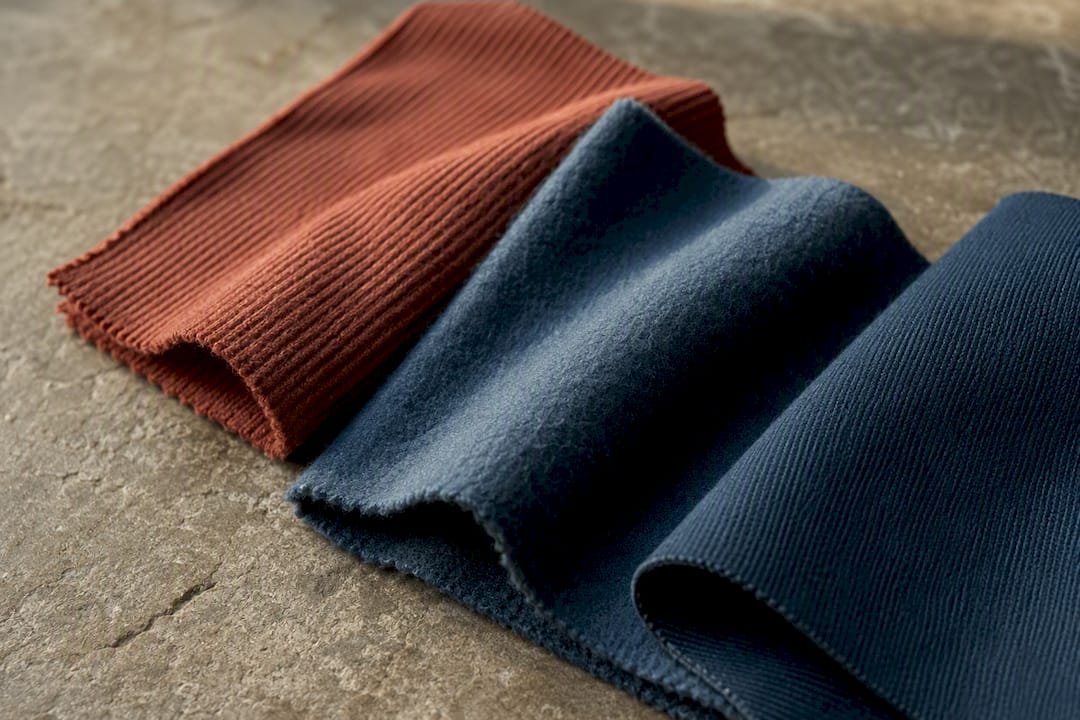
Lightweight fabric (roughly 220 to 300 GSM) hangs close to the body and moves with you, so a true-to-size chest measurement will usually feel accurate. Midweight fabric (300 to 400 GSM) is the sweet spot for daily wear and behaves close to what the size chart promises. Heavyweight fabric (400+ GSM) is stiffer, holds its own shape, and can feel boxier or smaller across the shoulders even at the same listed chest measurement, because it doesn’t stretch or settle the way a lighter knit does.
Shrinkage adds another layer. Raw, untreated cotton can shrink noticeably after the first wash, while pre-shrunk fleece barely moves. If a product page doesn’t say “pre-shrunk,” treat the listed measurements as a best case and consider sizing up slightly, especially in heavyweight, non-stretch cotton where there’s no give to compensate for a snug fit.
How Do You Convert Between Inches, Centimeters, and Chest Charts?
Some brands list inches, some list centimeters, and some list “1/2 chest” instead of full chest circumference. The math is simple once you know which version you’re looking at: one inch equals 2.54 centimeters, and a “1/2 chest” or pit-to-pit figure needs to be doubled to match a full chest measurement.
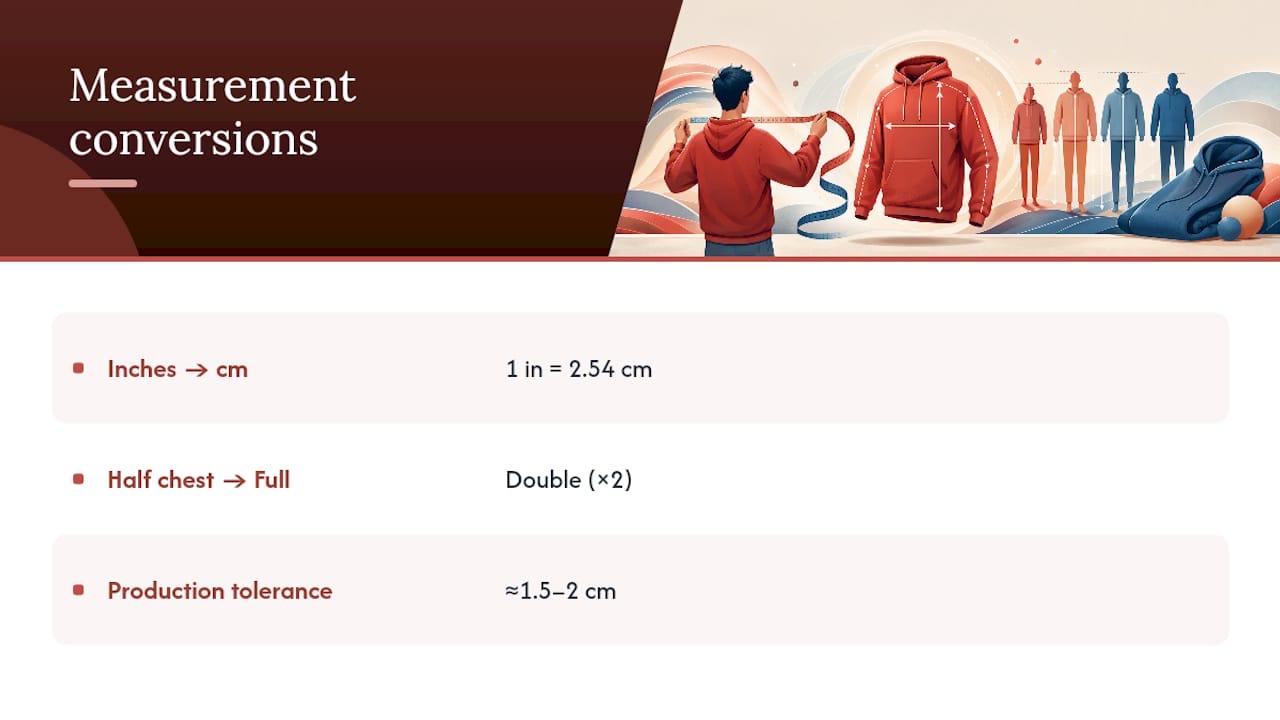
Manufacturing isn’t laser-precise. Most factories work within a tolerance of roughly 1.5 to 2 centimeters on any given measurement, so a garment that measures slightly off from the listed chart isn’t defective, it’s just within normal production variance. If your body measurement lands right on the boundary between two sizes, that tolerance range is one more reason to size up if you plan to layer, and size down if you want a closer, slimmer look.
How Do You Decide Between Sizes While Shopping?
Run through this before you check out:
- Compare your chest measurement, or your favorite hoodie’s pit-to-pit doubled, to the brand’s chart.
- Check the fabric composition and GSM. Stiff, heavy, non-stretch cotton fits tighter than the number suggests.
- Pick your size based on your fit goal: regular for a 1 to 2 inch pinch, oversized for 2.5 inches or more.
- If you’re between two sizes, size up for layering or an oversized look, and size down if you want a slim fit under a jacket.
- Verify the product page lists HPS length, sleeve measurement method, and pit-to-pit values before you commit.
Some shoppers keep a running spreadsheet of brand measurements and personal fit notes, which is a practical way to catch which specific models run large or small before you order again from the same brand.
How Does ThePreciousLamb Support Accurate Sizing?
ThePreciousLamb lists pit-to-pit and HPS measurements directly on product pages, so you’re comparing real garment numbers instead of guessing from a size label alone.
- Measure a hoodie you already own and trust before you shop.
- Compare that pit-to-pit and HPS figure against the listed product measurements.
- Check fabric composition on the page to judge stretch and shrinkage risk before checkout.
How Should Layering Change the Hoodie Size You Pick?
Layering changes the math more than most buying guides admit. A hoodie that fits perfectly on its own can feel tight and restrictive the moment you put it under a denim jacket or over a thick base layer, because the pinch room you measured assumed nothing else was competing for that space.
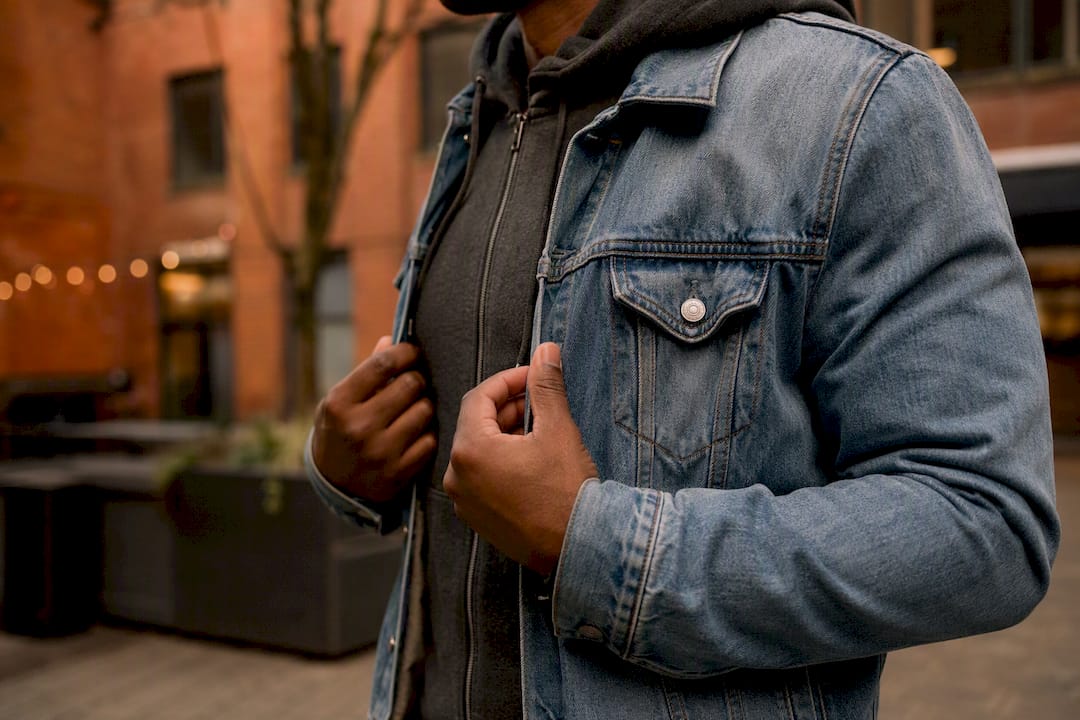
If you plan to wear the hoodie as an outer layer over a t-shirt or thin base layer, your usual size or even a regular fit usually works fine. But if you’re planning to wear it under a jacket, coat, or heavier outerwear, size down slightly or lean toward a slim fit, since bulk at the shoulders and chest will fight with whatever goes over it. Wearing a hoodie under a jacket works best when the hoodie itself isn’t already claiming maximum room.
The reverse is also true for oversized styling. If your goal is a deliberately boxy, layered streetwear look with a t-shirt underneath and a hoodie on top, size up beyond your regular fit and lean into that 2.5 to 3.5 inch pinch range, because the intended silhouette depends on visible extra fabric, not a snug base layer.
Sleeve length matters here too. A hoodie sized for solo wear might show too much cuff once you add a base layer that pushes your wrist position slightly. If you regularly layer, checking the sleeve measurement method (center-back versus shoulder-point) becomes more important, since a half-inch miscalculation shows up fastest at the cuff when you’re stacking layers underneath.
Do Men’s, Women’s, and Unisex Hoodies Use the Same Size Charts?
No, and treating them as interchangeable is where a lot of online orders go wrong. Men’s hoodies are typically cut with more room through the shoulders and chest relative to the waist, following a straighter body line. Women’s hoodies are usually cut with a narrower shoulder width, a closer waist taper, and often a shorter body length, even at the “same” labeled size like medium.
Unisex hoodies split the difference, and this is exactly why measuring pit-to-pit matters more than trusting the size label alone. A unisex size chart typically runs closer to men’s proportions in the chest and shoulders but skips the waist taper you’d find in a women’s-specific cut. A person who normally wears a women’s medium might find that a unisex medium runs boxier and longer than expected, simply because the pattern was drafted differently.
The safest approach across all three categories is the same: ignore the letter or label on the size tag and go straight to the pit-to-pit, HPS, and sleeve measurements on the chart. Those numbers tell you the actual garment dimensions regardless of which category the brand assigned it to. If you’ve measured a women’s cut hoodie you love and you’re eyeing a unisex style from a different brand, compare the raw numbers directly rather than assuming “medium” means the same thing twice.
How Does Pullover vs. Zip-Up Style Affect Sizing?
Pullover and zip-up hoodies aren’t just a style choice, they fit differently because of how the front panel is constructed. A pullover has a single continuous piece of fabric across the chest, which means the pinch test and chest circumference measurement translate directly and predictably. What you measure is what you get.
A zip-up hoodie has a center seam and a zipper track running down the front, which adds a small amount of structure and can make the chest feel very slightly more fitted at the same listed measurement, especially when zipped all the way up. The zipper also affects how the hoodie drapes when worn open, since an unzipped zip-up hangs more loosely at the chest than a pullover of the same size would.
If you’re deciding between the two in the same size, and you want a closer, more finished look, a zip-up in your regular size can read slightly more tailored than a pullover in that same size. If you want maximum room and don’t plan to zip it often, a pullover gives you a more consistent, predictable fit across the whole chest without a center seam interrupting the drape. Either way, check the zip hoodie fit and measurement notes on the product page, since zipper hardware and placket width can shift the effective chest room by a small but noticeable margin compared to a pullover cut from the same base pattern.
What People Get Wrong About Hoodie Sizing
Most sizing advice treats the size label as the variable that matters and the body as the constant. That’s backward. Your chest measurement doesn’t change from one shopping trip to the next, but what a “large” means shifts wildly between a heavyweight boxy streetwear brand and a lightweight athletic label, sometimes by three or four inches at the same size name.
The bigger blind spot is fabric. Shoppers obsess over whether to size up or down but rarely check GSM before deciding, even though a stiff 450 GSM heavyweight fleece behaves nothing like a soft 250 GSM lightweight one at the identical chest measurement. Sizing charts hand you a number; they don’t tell you how that number will feel once the fabric has its say.
If there’s one habit worth building, it’s this: measure a hoodie you already trust before you shop for a new one. Body measurements tell you what you are; garment measurements tell you what you’re actually buying. Treat the size chart as a translation tool between those two things, not as the final word.
Which ThePreciousLamb Hoodies Show Clear Measurement Data?
If you’ve already measured your go-to hoodie and know your ideal pit-to-pit and HPS numbers, shopping gets a lot less risky when the product page actually tells you what you’re getting instead of leaving you to guess from a size label.

ThePreciousLamb lists pit-to-pit and HPS measurements directly on product pages, which means you can hold your own numbers up against the listing before you commit. The Snow Washed Distressed Panel Pocket Hoodie is a solid example of that measurement transparency in an oversized, boxy cut, while the Vintage Washed Cropped Fleece Hoodie works well if you’re deciding between a regular body length and a shorter, cropped hem. Pull up the tape measure, check your favorite hoodie’s pit-to-pit against either listing, and you’ll know within a minute whether that size is the right call before it ever hits your cart.
Sources
- Hoodie Size Chart Generator: CM to Inch Converter (S-3XL)
- How a Hoodie Should Fit a Man: A Complete Fit Guide 2026
- The Ultimate Hoodie Size Chart Guide : Slim, Regular, & Oversized Fits – Topology Apparel
- I made a Hoodie spreadsheet to help you with sizing